
The intention behind Michael Haneke’s Funny Games in 1997 was to highlight the immoral nature surrounding the depiction of violence in the media. The film, whilst receiving critical and audience praise, was according to writer/director Haneke, supposed to be filmed in the U.S. This is because the U.S. was the main culprits in Haneke’s eyes in the evolution of criminally televising, popularising, sensationalising and dramatizing (or severely dedramatizing) media violence depiction. However, due to budget constraints, the film was shot in Austria where it received a wide European release. Still dissatisfied with the lack of recognition in the States, Haneke persevered and, in 2007, remade Funny Games in America, shot for shot.
Films I reference/potentially spoil in this article:
- Funny Games (dir. Michael Haneke, 2007)
- Funny Games (dir. Michael Haneke, 1997)
- Irreversible (dir. Gaspar Noe, 2002)
- The Texas Chainsaw Massacre (dir. Tobe Hooper, 1974)
- The Truman Show (dir. Peter Weir, 1998)
To some extent, the film succeeds in conveying this message, but it doesn’t address it directly. Despite bearing obvious cues like having the antagonists break the fourth wall to address the viewer, asking for our take on the presently active torture, misery and Sodom that they’re inflicting on our helpless protagonists, the film very nearly falls into the genre that it’s condemning. There are other films that offer similar experiences such as The Texas Chainsaw Massacre that feature similar detestable and sickening content, but these similarly-natured films are also not stating that they are attempting to convey messages about anything; they are not films made to chastise their viewers. Irreversible is another example which features a notoriously controversial rape sequence; the film even adds a capitalised title card of, “TIME DESTROYS ALL THINGS” just to remind you of the negative mindset the film will leave you with. Both films leave you feeling upset, but for many, there is no guilt for this because it was your decision to put yourself through that. This is what Haneke is trying to get at; we are perhaps intrinsically at fault in some way for choosing to watch these films, damaged on a psychological level, unhealthily progressing our desensitisation to the point where we begin to sympathise or idolise serial killers rather than fear and condemn them. This is certainly accurate given our Netflix-fuelled obsession with serial killer docs and the memes that sprout from these real-life cases with real-life deaths and real-life consequential mourning.
My point, however, is this. The aforementioned examples, The Texas Chainsaw Massacre and Irreversible are more-or-less equal in their usage of producing shock value. Funny Games also reaches similar levels; the three films are deprived of any remote themes of happiness or pleasure, instead, focusing on the horror of twisted minds resulting in murder, rape and torture. If any of these three films bared the moral question that Haneke is asking with Funny Games, no doubt we would perceive them in that way, the way intended by the artist/writer/director that birthed it. So, if Haneke weren’t to suggest that this film is a reflection and awareness-raising, finger-pointing piece of cinema, it would arguably have been received as yet another one of the torture-porn films that it is supposed to be satirising. Consequently, Haneke’s anti-torture-porn-fetishization movie isn’t a torture-porn-fetishization film because he declared that it wasn’t upon release. It’s an interesting paradox because the antithesis of this argument is that Haneke did make the film and did tell us how to watch it. It’s just unfortunate to think that a viewer without this information in mind would most probably be unaware of this greater context, unaware that it was an attempt to teach them a lesson regarding the depiction of violence. Also, the film is so compelling and intriguing and is an extremely well-constructed thriller, so much so that I found myself watching primarily for the story as opposed to questioning my passivity when it comes to violence.
Funny Games stars Tim Roth and Naomi Watts as George and Ann who are on vacation. They take their son Georgie (Devon Gearhart) to an idyllic holiday house by a gorgeous lake where before long, they are taken hostage by two psychopathic young men named Paul (Michael Pitt) and Peter (Brady Corbet). The two men methodically structure their torture as a series of games, but these games only have one outcome which always lands Paul and Peter as the winners. At first, it’s play or die. Then, it’s decide how you die. If you don’t play, you die. As the family makes several weak attempts at escape, all of which are extremely consequential to the wellbeing and fate of one another, we soon realise that there’s little hope for the family as their collective situation becomes rapidly dire.
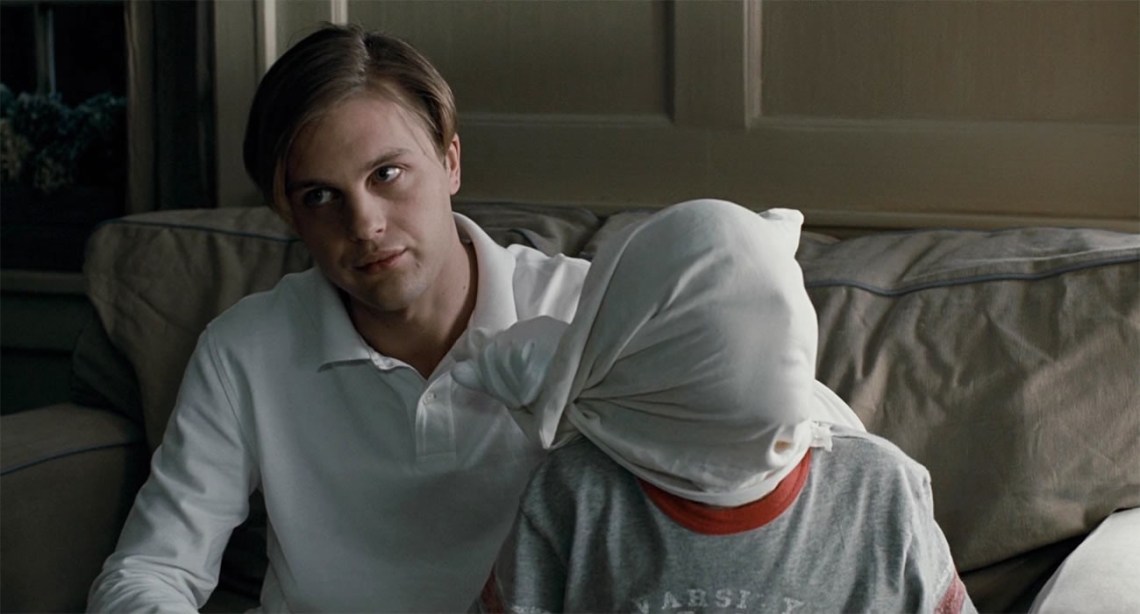
Image Credit: HeadStuff
The sense of dread created by the young men is complemented by wonderfully clean cinematography and efficient direction. Like with our helpless but hopeful protagonists, time isn’t wasted as scenes move at a steady pace with enough minor twists and incidents to keep your interest. A particular example of perfect pacing meets perfect direction is one early in the game when George is attacked with a golf club. The camera moves no faster than it did before the scuffle, making the atmosphere sedated and dismal and depressed, all of which contribute to this overwhelming sense of powerlessness. Framing is also superb. The unpredictability of Peter and Paul is heightened by their elusiveness. For one extended sequence about two thirds through the film after Georgie is murdered, there is a horrific sequence of the parent’s shock and mourning. We do not see Paul and Peter for the longest duration yet. You know this is part of their game and that they will return, but when, where and how is the question; no doubt Haneke’s intention to probe the audience’s morbidly curious reasons for staying, as though asking us ‘why are you still here watching this, wanting more?’ Near the beginning, similarly, when Peter visits Ann to request eggs for a meal they are cooking, the camera follows her as she moves to the fridge. When she walks back, Peter is a couple of feet closer to her. This is a great example of a common-yet-effective method of filmmaking applied in perfect fashion. Pacing also compliments nearly every scene in the film. For the most-part, Funny Games is presented in real-time, making the twelve-hour duration of the fixed game of survival feel just as long and dread-inducing as it is impossible to win.
Peter and Paul are superbly devised characters. Their intentions seem to be out of sheer boredom, which is perhaps the scariest part about them. When Ann, the final survivor of the game is tied up, gagged and being sailed out to somewhere with the two men, her demise is met with what appears to be mere boredom. They realise she has only an hour left to ‘win’, so Paul casually, matter-of-factly just pushes her into the water to drown. The two then continue their conversation about physics and black holes as though that didn’t just happen, bored of their own game that had gone on a little too long for their liking. They moor up by another lady’s house and ask her for eggs, much like the way they met Ann, commencing another game. This ending reminds you of the beginning of the film where you first see Peter and Paul with a different family behind the gates of their house. When George and Ann conversate with them, the family are weirdly slow and cautious in their replies. No doubt, this is because Peter and Paul had them as their current hostages. It’s a tragic cyclical metaphor for the endless onslaught of media violence that we are presented every hour of every day, if we are to abide by Haneke’s intentions. When asked in desperation by George and Ann why they are being put through this, Paul simply replies ‘why not’. Later, Paul provides a more thorough answer, telling them that Peter is the way he is because he grew up with an alcoholic father with five siblings, implying that he may be a victim of abuse or neglected or devoid of attention. Paul quickly reassures them that was a lie. He then lies again, saying that they’re junkies. Then, his most believable response is that they’re both “jaded by the emptiness of existence”. This is the most believable given their forever bored, never stressed, scarred or hurt attitude, along with the masterful control of their games that you can tell have been played many, many times before, so much so that it’s losing interest to even them. Ann being thrown out of the boat is like her being cast into the empty void of the all-consuming black holes that they chat about, her life as meaningless as existence itself.
The fact that the two are so incomprehensible makes them great villains for a film like this and also great illustrations of what Haneke is trying to communicate with us. They are unlike depictions of school shooters that we regularly see on news reports; they are young men, loners, depressed by their lack of purpose in the world and also empowered by the fact that nothing ever matters, rid of all the mutual empathy and compassion that regular people feel for one another. There is also a heavy reliance on the distracting nature of television. One particular shot in the film became increasingly ingenious to me only after watching it. Shortly after Georgie is murdered by a gunshot, the camera, stationary points at the TV, which is now soaked in this innocent child’s blood. The TV continues to function, in which a car race event plays. The shot of the blood-soaked screen not ceasing to play what’s on is a devastatingly powerful metaphor for how our attention is diverted by the other entertainment it also presents to us. As this scene plays on, you can’t help but find yourself watching the race. Similarly, on a much-less intense but just as meaningful level, the ending to Peter Weir’s The Truman Show also presents to us the idea that a person’s entire life can be changed forever, but because you’ve only known them through a television screen, you are far less impacted by their trials and tribulations than if you were to know them personally. In a scene that cements your certainty that Ann is definitely going to die, she at one point is able to steal the loaded shotgun from Paul and kill Peter. In shock and outrage, Paul scrambles for the TV remote in the lounge. Upon finding it, he physically rewinds this entire sequence, so that the past few moments play in reverse and resumes the scene with this premature knowledge and snatches the shotgun away before she can grab it. This is both another statement about the ever-controlling nature of television and how our antagonists are forever in control. It becomes clear at this point, despite the occasional smirk at the camera or comment to the audience about what we would like to see, that this is a film pointing its finger at us for enduring such depravity when we know the ending already yet are so sick that we want to see exactly how and in what precise fashion it will all play out.
Naomi Watts’ performance is extraordinary. By no feat is it easy to be convincingly drained, emotionally and physically throughout the entirety of a film, but this is something that both herself and Tim Roth achieve at a superb level. Tim has this aura of uselessness and knocked pride that expands constantly until his characters death, whilst Naomi manages to maintain not only a certain level of unpredictability and confidence but a sense of overwhelming defeat in every scene. Michael Pitt and Brady Corbet are an amazingly well-paired double act with incredible chemistry. I’d say Brady’s performance is the show stealer though as, paralleling Watt’s character, his ability to act unpredictably is powerfully unsettling. His soft-spoken voice also naturally lends itself to Peter’s quiet nature. Michael Pitt manages to achieve a great performance, notably due to his lack of extreme expressions that we are used to with the character of the psychopath. His blank expression often makes his performance seem underpowered, but this is only until you realise that that is the reason why his character is unsettling. If he were to implement characteristics such as twitchiness or an over-emotive face, he wouldn’t be the character that Haneke wrote. Pitt needs to play someone who is bored of everything, even the very games that his character has invented, and in doing this, he succeeds monumentally.
You can watch Funny Games in numerous different ways, the main two being with a knowledge of what the film is about beforehand or with no knowledge. Without knowledge, the layman review would most probably layer the film with compliments and praise regarding its skilful craft of horror-thriller making, perhaps acknowledging the film’s depressing outcome (and journey to this outcome). To those aware that this film is a telling-off about our morbid curiosity in cinema, they’d most probably come out with a similar review but with the added pressure of questioning themselves; should I feel guilty? I believe the greater context of Haneke telling us what the film is, is the only thing that separates Funny Games from what Haneke doesn’t want it to be viewed as. Watch with warning.
Loved:
– A powerful and well-crafted, thought-provoking thriller
– Great performances all round
– Slick, efficient direction and cinematography
Didn’t Love so much:
– Despite its message, little of anything new is brought to the table here
– Mixed messages regarding how and why it is chastising the audience
– Misleading title: the film is not funny

 filmmish