Barry Lyndon is a strangely enigmatic character, the extent his mystery reaches making his life story extremely engaging to watch. Despite observing his turbulent life for several years over the near three-hour duration of the film, just as I thought I was able to at least hazard a guess as to what his next action would be or how he’d respond to each newly arisen crisis, his decision would ultimately surprise me. I’d like to think that I’m not alone in my inability to trace this slippery character’s next moves.
Films I refer to/potentially spoil in this article:
- Barry Lyndon (dir. Stanley Kubrick, 1975)
- The Stanford Prison Experiment (dir. Kyle Patrick Alvarez, 2015)
- Full Metal Jacket (dir. Stanley Kubrick, 1987)
- The Master (dir. Paul Thomas Anderson, 2012)
- Magnolia (dir. Paul Thomas Anderson, 1999)
- Apocalypse Now (dir. Francis Ford Coppola, 1979)
- Aguirre, Wrath of God (dir. Werner Herzog, 1972)
- The Favourite (dir. Yorgos Lanthimos, 2018)
- The Shining (dir. Stanley Kubrick, 1980)
- Eyes Wide Shut (dir. Stanley Kubrick, 1999)
Set in 18th century England, Kubrick writes, directs and produces this adaptation of the 1844 novel The Luck of Barry Lyndon by William Makepeace Thackeray. The luck suggested in the title however is equalled in bad luck, as we witness both the rise and fall of Mr. Lyndon, both the climb to the top being as relentlessly dramatic as his demise. First, we meet his father at the beginning of the film where he is shown dying in a duel. This rather appropriately sets the bleak and foreshadowing tone, bettered by a matter-of-fact and unimpressed-sounding narrator. We meet Barry, who, perhaps due to a lack of fatherhood in his younger years, is riddled with angst and a lack of self-respect; he is unable to cope with his own lack of superiority. He soon sparks a vicious rivalry with Captain John Quin, an elegantly dressed and talented soldier who dances with Barry’s first love, who just so happens to be his first cousin. Upon requesting a duel, Barry (believes he) kills Quin and is told to flee to Dublin by his family for fear he’ll be caught and imprisoned for his actions. It’s a hell of a set-up for the start of his story which is told through what feels like several short stories joined together.
Part of Barry Lyndon’s ability to hold your attention consistently is due to his character’s ever-changing status within the world. In early scenes, Barry is nervous and awkward in sexual encounters. However, fast forward an hour and Barry has stolen the uniform and identity of his army superior of the legion he’s been drafted into. With this new outfit comes new charisma and self-respect, as later we seem him during a chance encounter with a young lady. They take to one another and with newfound confidence, Barry stays the night; it’s like watching a different person entirely. Little has changed in him other than the uniform, but it’s what the uniform constitutes and represents that alters Barry’s perception of himself. It’s an interesting examination as to how a mere reflection of oneself can not only allow one to surpass security and enter new territories and consequently enter new opportunities but the perception that the person has of themselves. In many ways, it’s reminiscent of the notorious real-life study of human psychology in 1971, which saw several young men imitate prison officers and inmates in a prison setting, and despite role-playing, the experiment was cut short due to the violence and depravity that ensued, merely as a result of fictional hierarchy and superiority. That experiment was adapted into a well-made film called The Stanford Prison Experiment.
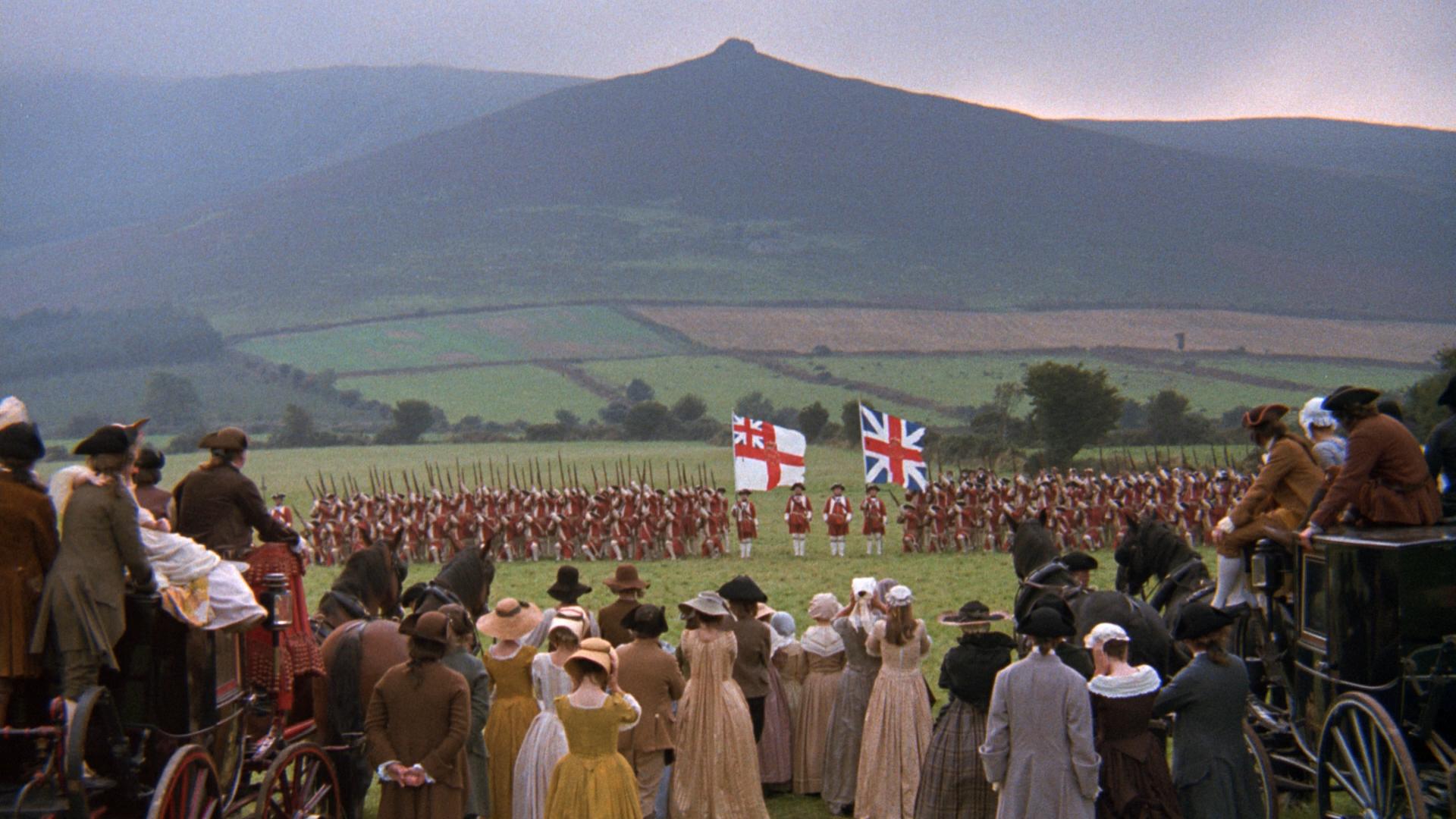
Image Credit: Wallpapers Vista
Just when you think Barry Lyndon is attaching itself to a tangent, such as this theme of identity, it pulls away and enters a new zone, devoid of the themes and characters from the one prior. This isn’t to say that it completely starts fresh, such as in Kubrick’s film Full Metal Jacket which notoriously changes its focus during the film to a totally new chapter and a separate array of characters. Barry Lyndon however, retains the features of importance from the preceding events and takes them to a new location with new characters and a new atmosphere; ultimately, the story is just about Barry. It’s what makes the title of the film so ingenious. Why aren’t we disappointed when a film about a man in the army turns into a man getting married, or why a man who’s on the run for murder is now raising a child? Because we know where he’s come from but not where he’s going, as ultimately, everywhere he is, he’s out of place and in need of something different. His demands are never quite satisfied, his misfortune an equal rival to his good luck. We watch out of intrigue to see where his past will end and his future will commence, if ever. This sounds like an extremely stripped back and basic formula, essentially a dissection of the fundamentals of any narrative plot within a film; surely, the reason we watch anything is to see what happens next? Barry Lyndon however, manages to cast this spell in a massively captivating way, and I believe that is due to two primary reasons; firstly, his malleable nature as a character, and secondly, the easy-to-follow and gorgeous form in which it is told.
To elaborate on the first of the latter points, Barry’s life is structured in episodical stages; each new circumstance happens to come to him rather than vice versa. His limited skills derive him of abilities to make waves in the plot, so, as the title of the book suggests, the narrative is very much derived from luck and misfortune. Much like Joaquin Phoenix’s character Freddie Quell in Paul Thomas Anderson’s The Master, Lyndon is somewhat aimless and ends up wandering into new situations having fled from the last, making him a drifter with a cause of some sorts. His presence is resemblant of a character from a fable or children’s story as he seems haphazardly misplaced wherever he is which is a result of his own misfortune. In one scene, soon after marrying his wife who exceeds him in almost every standard but most noticeably social status, Barry’s mother reminds him that if she were to die, he’d be left with nothing because he came from nothing. He’s the 18th-century definition of ‘fake it til you make it’, but the elephant in the room is the moral question of just how entitled is he to his new wife’s money, or to what extent may he discipline her child? He’s got himself here through mischievousness and deception, taking chances that would only be considered by a gambler. The film delves into how our roots may define us; to quote one of my favourite films Magnolia, “you may be through with the past, but the past ain’t through with you”.
If Apocalypse Now and Aguirre, Wrath of God are considered two of the titans of hellish film productions for cast and crew, then Barry Lyndon is an equally nightmarish heaven for costume and set designers. Every scene and frame of this film is immaculately decorated with period-era historical detail, but some of these scenes are only used briefly as transitional shots to stitch scenes together. Heaps of extravagantly dressed extras mill about in the background of almost every shot in the latter half of the film; my thoughts go out to those that spent hours composing such scenes only for them to grasp a few seconds of limelight on the big screen. However, this time is well and truly not wasted. Each minor detail compliments the next and the result is a wholly immersive, living and breathing world. Kubrick’s recognisable and distinct visual style allows this rich production to bask in long shots, wide shots and close-ups. The film also lives up to its widely renowned reputation for being a beautiful movie visually. Stories, such as the fact that Kubrick used lenses from NASA to shoot indoor candlelit sequences seem to be remembered more than the remarkably adapted screenplay and stellar performances. It’s almost a reverse of the reception that the Yorgos Lanthimos film The Favourite received, which managed to disguise a slow and uninteresting plot with a unique visual style which defies the regular conventions of what a period piece traditionally looks like. Thankfully, Kubrick’s signature visual motifs are generally diluted in Barry Lyndon. The rigid cinematography that he stuck with in later films The Shining, Full Metal Jacket and Eyes Wide Shut is certainly resemblant in Barry Lyndon, and, although visually distinctive, I often find myself distracted by the practical characteristics of these signature motifs. Barry Lyndon succeeds in both managing to communicate the story whilst justifying the prominent use of symmetry and heavy composition in many of its frames. Every frame looks like a classical painting thanks to composition, natural lighting and a broad colour range. Occasional scenes set outdoors see the clouds alter the light of a shot; on most outdoor film sets this would be an inconvenience and the scene would likely be shot again. Here though, simply by allowing nature to do its thing emboldens this world, making it even more invigorating and encapsulating. There have been references to Andrei Tarkovsky films to Barry Lyndon which I recognise and agree with, given the attention and respect given to the natural world the film takes place in.
Barry Lyndon is a joy to watch. It’s a masterful, genre-blending extraordinaire that makes the telling of a large portion of a man’s life appear seamless. It’s filled with wonderful performances and set pieces, particular kudos going to leading man Ryan O’Neal and a gripping duel that happens near the end of the film, a masterclass in tension being conveyed through actions, visuals and audio design as opposed to excessive dialogue. Even if period-era pieces aren’t your thing, Barry Lyndon offers something for everyone. It’s an iconic and memorable journey that modestly shows off each and every wonderful frame. Filled with memorable sequences about primal human emotion coveted in extravagant clothing and thickly plastered make-up, we learn about the unexpected and identity and dignity through the eyes of Barry Lyndon, a gambler, a hypocrite, a loner and a winner, where only at the end do you realise how far you’ve come. A gem from Kubrick, unfortunately, shadowed by his other, less deep and less versatile films.
Loved:
- One of the most visually gorgeous films I have ever seen
- Great, versatile performances and well-written characters
- Malleable utilisation of different methods of storytelling, from dialogue-heavy to visual-reliant silent sequences
Didn’t Love so much:
- A minor complaint; the chapter structure which essentially reveals to you before the chapter has begun what will happen by the end of it. Could be done without to enable more of an element of surprise and discovery
- Although everything happens for a reason, some scenes in the middle of the film feel a little long and drawn out, but this is another nit-pick for the sake of criticism!

 filmmish